Exxat Design OS is the shared language behind that clarity: one shell,
sensible defaults, and stable patterns across Prism, One Schools, and
One Sites. Every role meets the same product. Simple on first visit.
Full depth when someone asks. Neither path pays a cost for choices
they did not make.
Make it straightforward for teams to design, build, and ship interfaces
where important work stays clear: trustworthy, familiar, inclusive,
and empowering for every role.
Teams should not reinvent the shell, the list, or the next action.
People using the product should always know where they are, what
needs them, and how to go deeper when their work demands it.
Benefits
Using Design OS is a choice to share one language. These are the
returns of that choice.
Scale across products
Tokens, components, and patterns live in one place. Prism, One
Schools, One Sites, and Design OS itself stay aligned as the
suite grows. Quality does not fork with each new surface.
Faster to build, cheaper to keep
Designers start from hubs and primitives that already exist.
Engineers compose reusable code. A change to a pattern lands
everywhere it is used, including after launch.
One experience
People should not relearn the product when they move between
products, programs, or roles. Standard patterns create muscle
memory for navigation and for the work itself.
Decisions stay
When a choice lives only in someone's head, it leaves with them.
Design OS keeps the decision in the open: philosophy, patterns,
rules, and working examples in the product.
Knowledge that compounds
Documentation, skills, and the working app are the same source.
New people onboard against the product, not against a slide deck.
Agents read the same language.
Values
Values are beliefs that steer direction. Use them when you are choosing
a path, not a control. If a value cannot change the recommendation,
it is not doing any work.
Trust
People should always know where they are, what needs them, and what
happens if they act. Uncertainty erodes trust in work that matters.
Hidden status, clever labels, and competing next steps all create it.
The first screen answers “what needs me?” before it answers “what exists?”
Actions are named by outcome. Save changes. Review placements. Send invite.
Errors name the failure and the next step. They do not hide behind a generic message.
Familiarity
One vocabulary and rhythm across products, roles, and visits.
Navigation stays in the same place. The same gesture produces the
same result. The second time through should be faster because
nothing moved.
Lists, records, settings, and focus work keep a stable structure.
Search, back, and the primary action live where people already reach for them.
Role and frequency change density and defaults, not the underlying pattern.
Inclusion
Everyone uses the same product with the same ability to act.
Inclusion is not a score at the end or a separate mode. It is how
we build from the first version.
Keyboard, contrast, names, and targets are part of the product, not a later pass.
If someone cannot reach it, they do not have it.
High contrast and reduced motion are choices people keep, not exceptions we add.
Empowerment
Defaults carry the work. People go deeper when their role and
frequency demand it, without entering a separate advanced product.
Customization is layered, never required.
If someone never opens Properties, the product still does its job.
Views, columns, density, and filters live behind one consistent door.
What someone tunes stays tuned for them. Nobody inherits another person's layout.
Principles
Each principle is a tradeoff. The first clause is what we choose.
The second is what we refuse. When two principles pull, the higher
one wins.
Clarity, then Access, then Focus, then Consistency.
01
Clarity
Clarity over cleverness.
Think intent first, not feature. A request that names a widget is a
symptom. Design the experience that fulfills the intent, then pick
the pattern. If two options are equal in the system and one is
obvious to the person using it, choose the obvious one.
Apply it
Clarity over cleverness. Save beats Persist. Send invite beats Submit.
Show data to perform the work, not data over the work. Show what changed, then show the rows.
If a control needs a tooltip to be understood, the control is wrong.
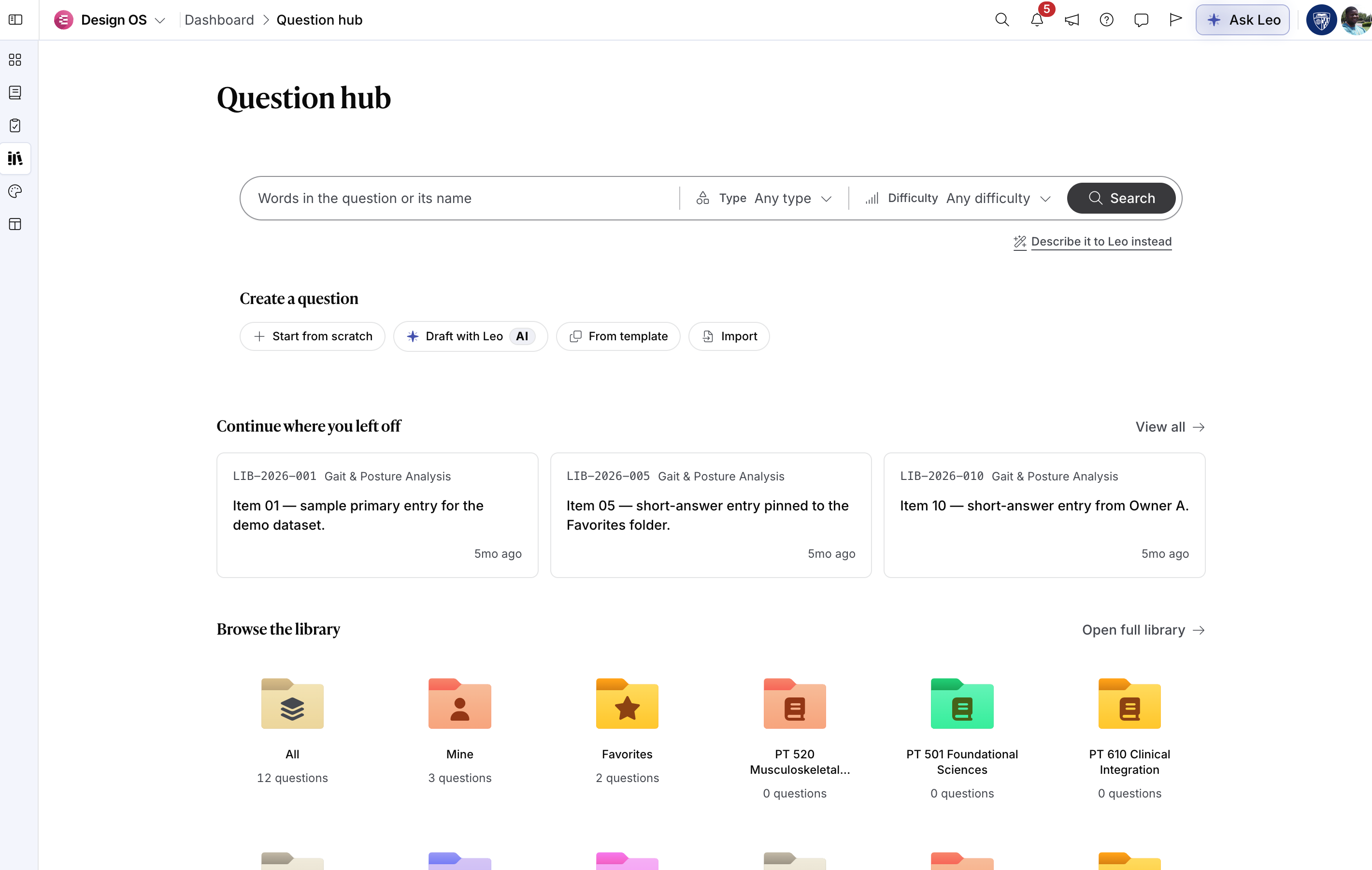
Question hub. People arrive with an intent: find, create, or resume.
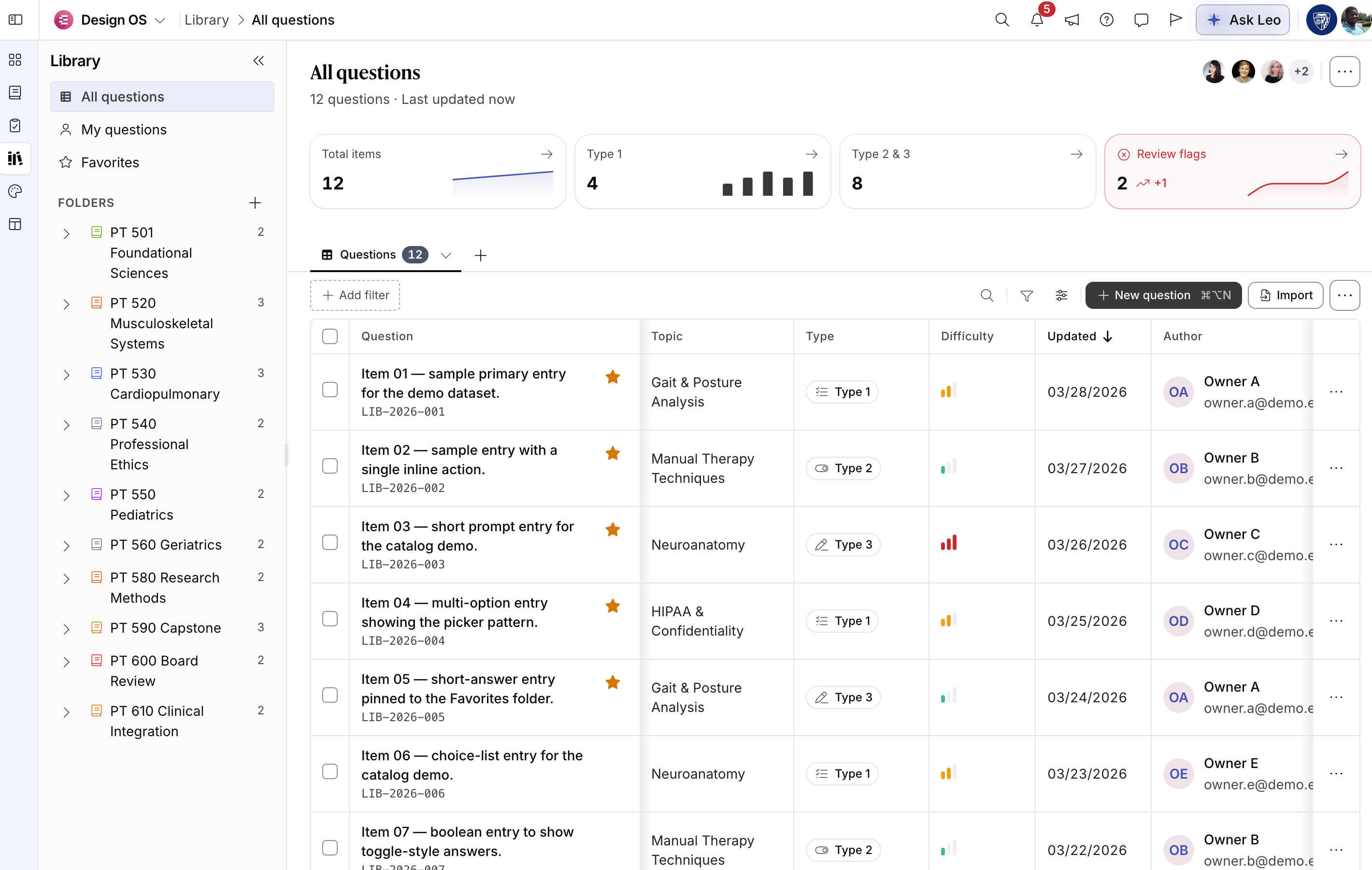
All questions. The same work, organized as a list once the intent is to browse and act on many records.
02
Access
Inclusion over density and decoration.
When access and density pull against each other, access wins.
Contrast, keyboard paths, names, and target size are not extras.
They are how everyone keeps the same ability to act.
Apply it
Every mouse action has a keyboard equivalent. Focus is always visible.
Icon-only controls have a name. Charts have a readable data table.
Empty, error, and loading ship with the happy path. Confirmation stays on the surface.
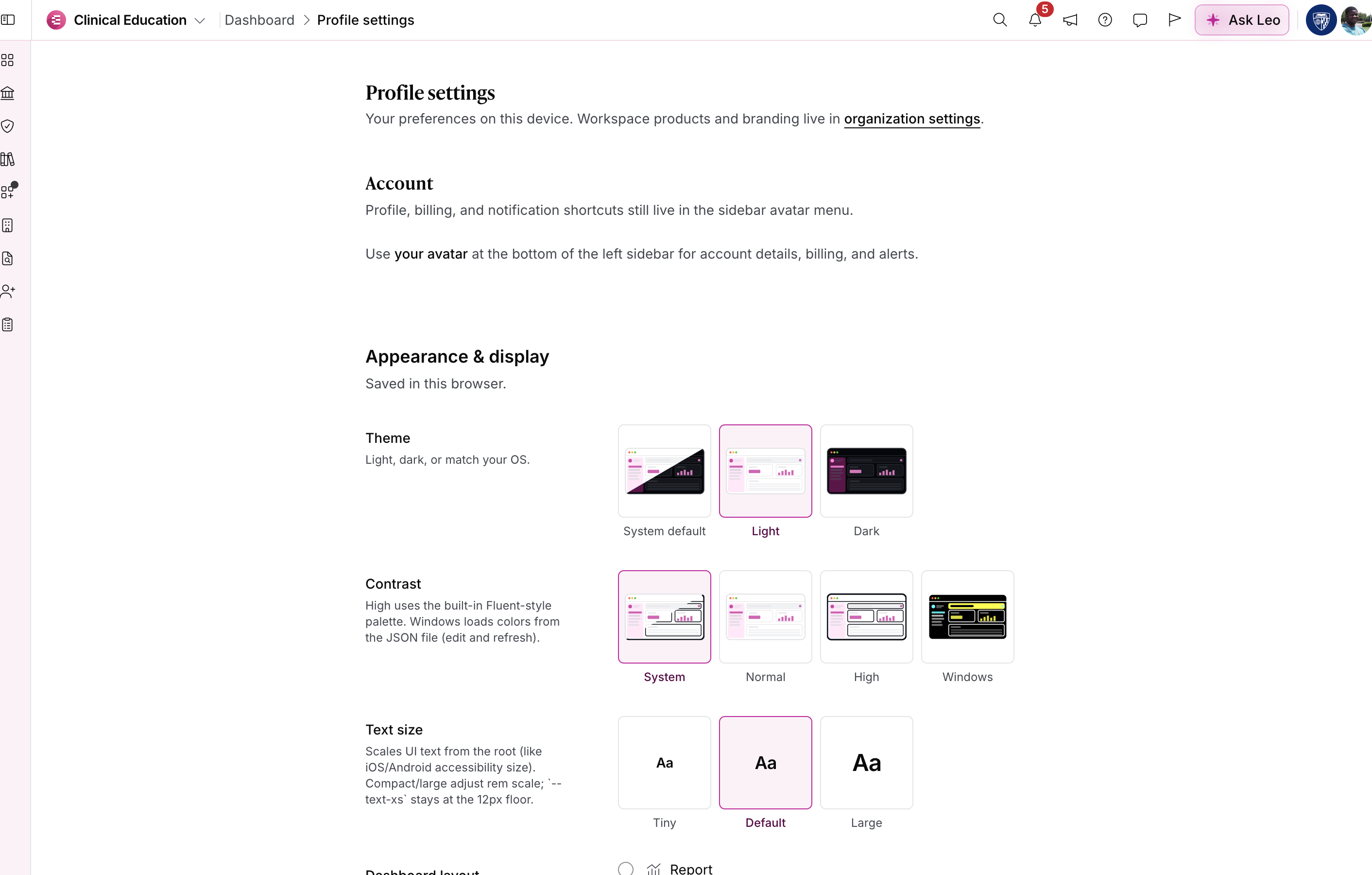
Appearance. Theme, contrast, and text size are how people keep power over the display.
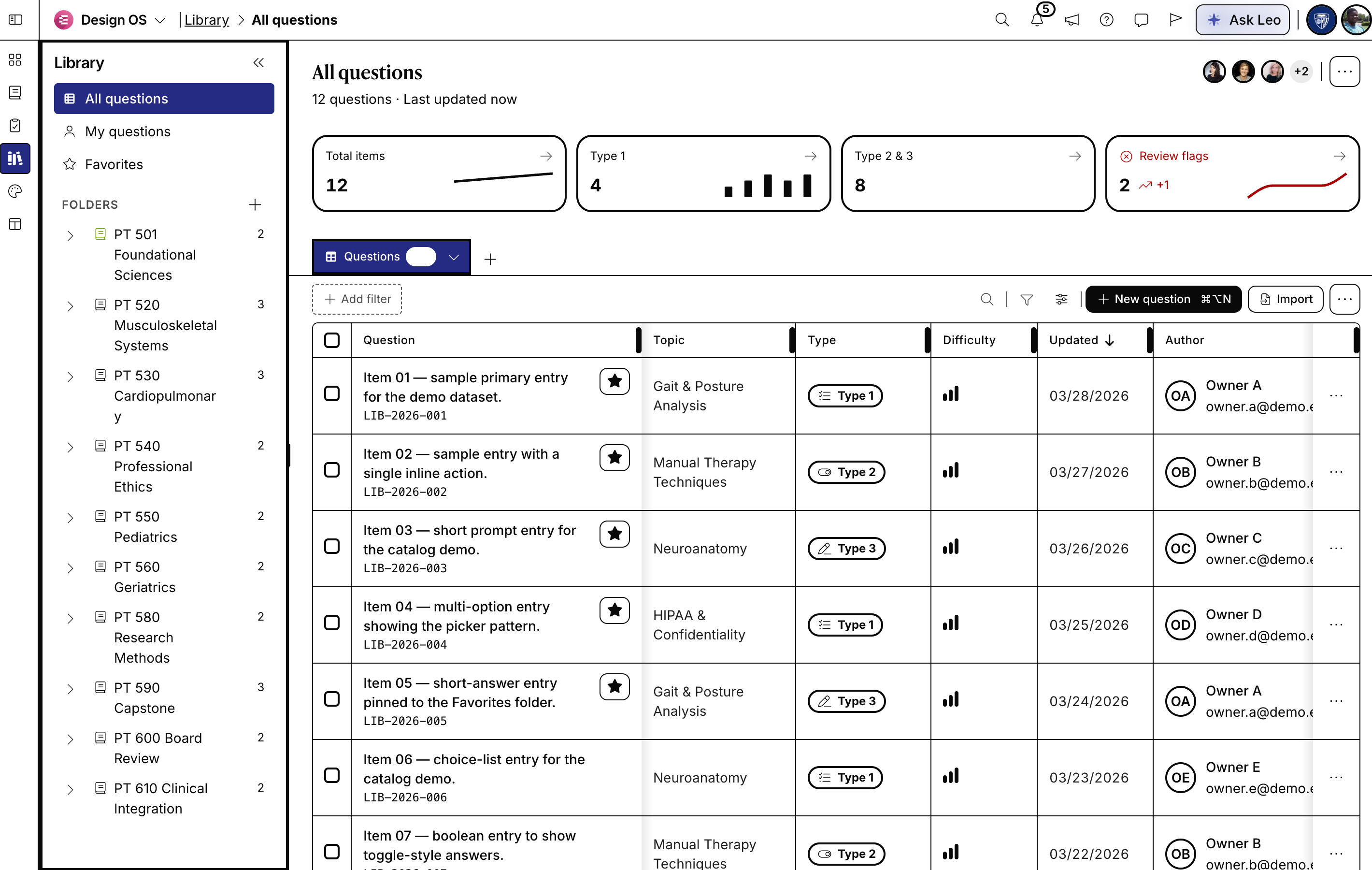
The same list in high contrast. Access ships with the product, not as a mode we add later.
03
Focus
Focus over feature stacking.
One primary on the screen, not three jobs stacked. Core first.
Depth on demand. Show less, ask less, and still let the person
finish. Occasional users should not step over tools that only
daily users need.
Apply it
One filled primary. A pair such as Approve and Reject is both outline.
Status that drives a decision sits above the fold, not on a later tab.
Compose and exam lock drop surrounding chrome until the task ends.
Hub work stays plain on the surface. Properties holds the rest until it is opened.
Decoration that does not change a decision does not ship.
The hub. Many records, one primary, chrome for find and compare.
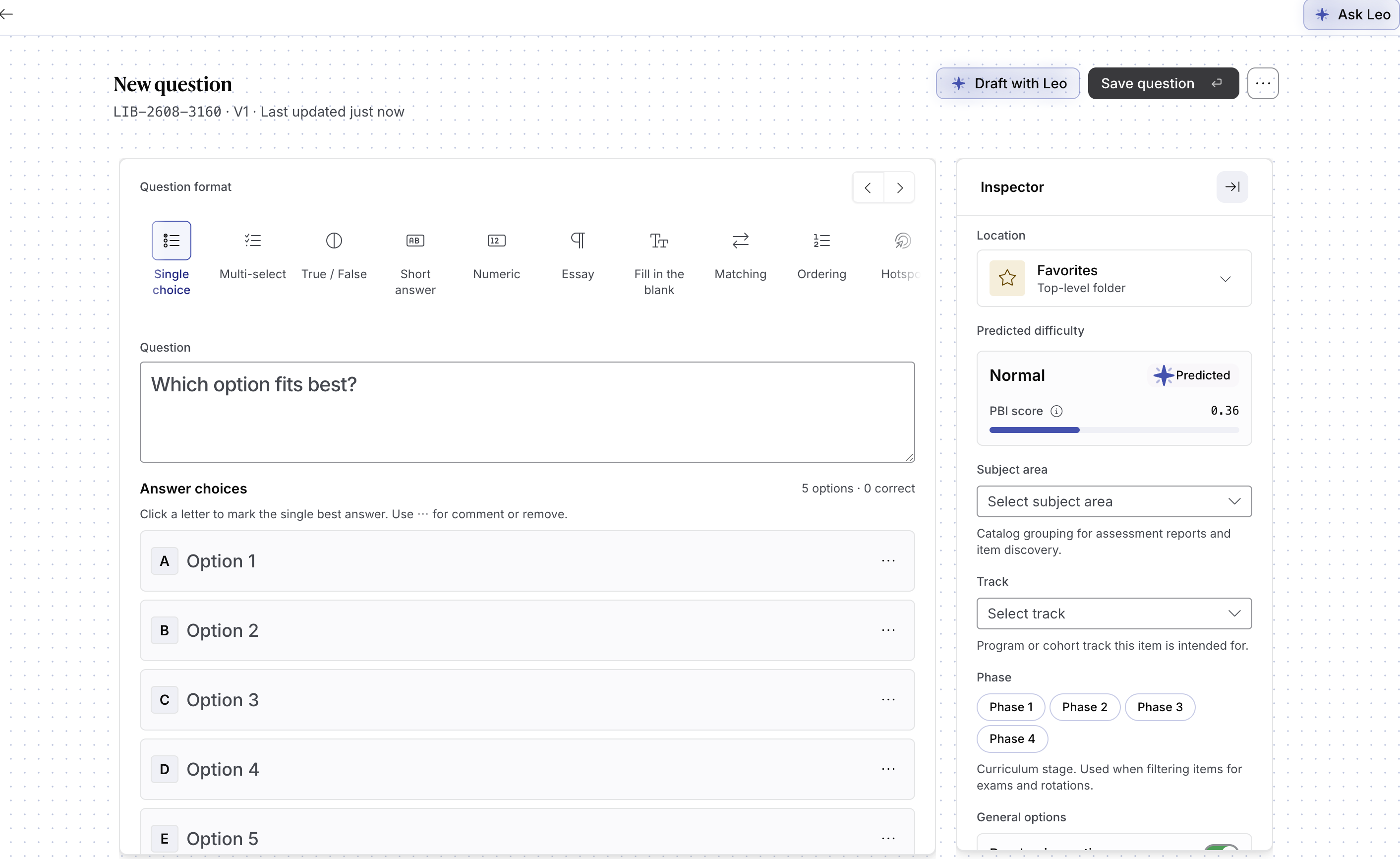
New question. Surrounding chrome waits. One task stays on the screen.
04
Consistency
Consistency over novelty.
Same pattern, same place, same result. Muscle memory is how people
move faster the second time, in navigation and in the work itself.
A new shape is a tax paid on every later screen.
Apply it
Start from the existing list, record, or settings pattern before composing a new one.
The same gesture produces the same result across products.
Search, back, and the primary action live where people already reach for them.
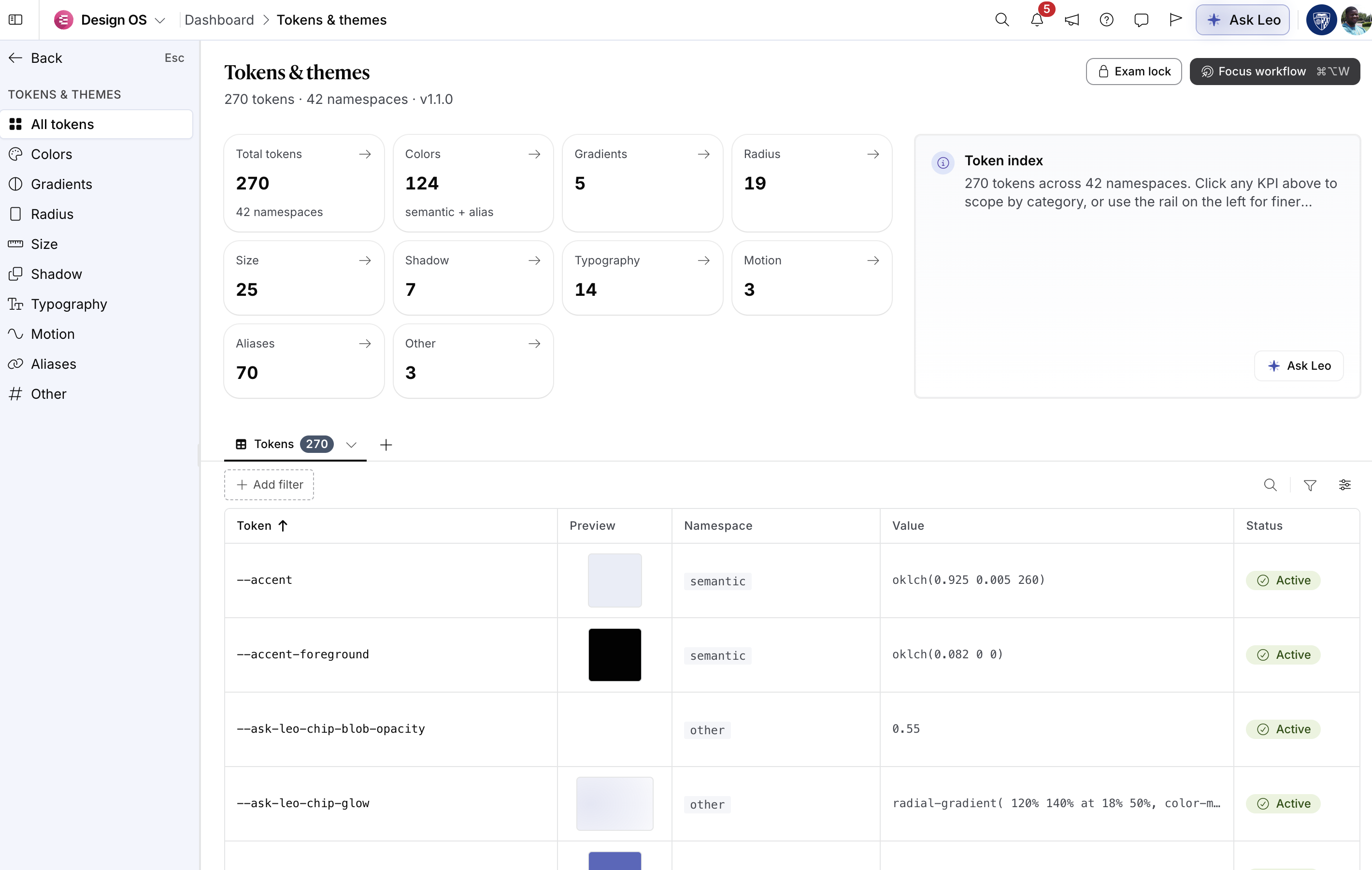
Questions. Rail, metrics, table, and search in the same places as every other hub.
Tokens. Same shape, different records. Muscle memory does the navigation.
Tenets
Tenets are one-line choices. Each names what we show and what we
refuse.
Think intent first, not feature.
Clarity over cleverness.
Show data to perform the work, not data over the work.
Same pattern, same place, same result. Muscle memory over novelty.
Access over density and decoration. Reach is not optional.
Every mouse action has a keyboard equivalent. Focus is always visible.
One filled primary. A pair such as Approve and Reject is both outline.
Core first, depth on demand.
Defaults are the experience. Customization is layered, never required.
Simple for the first session. Full power when someone asks for it.
Adapt to role and frequency without forking the product.
Way back is obvious, and used once.
Empty, error, and loading ship with the happy path, not after it.
Confirmation stays on the surface. It does not vanish.
Guidelines
Guidelines take the principles into specific surfaces. They are the
next layer, not a second philosophy.